- English
- Español
- Português
- русский
- Français
- 日本語
- Deutsch
- tiếng Việt
- Italiano
- Nederlands
- ภาษาไทย
- Polski
- 한국어
- Svenska
- magyar
- Malay
- বাংলা ভাষার
- Dansk
- Suomi
- हिन्दी
- Pilipino
- Türkçe
- Gaeilge
- العربية
- Indonesia
- Norsk
- تمل
- český
- ελληνικά
- український
- Javanese
- فارسی
- தமிழ்
- తెలుగు
- नेपाली
- Burmese
- български
- ລາວ
- Latine
- Қазақша
- Euskal
- Azərbaycan
- Slovenský jazyk
- Македонски
- Lietuvos
- Eesti Keel
- Română
- Slovenski
- मराठी
- Srpski језик


How Does an Eddy Current Separator Deliver High-Efficiency Non-Ferrous Metal Recovery?
An eddy current separator is an advanced magnetic separation system engineered to extract non-ferrous metals—such as aluminum, copper, brass, and zinc—from mixed waste streams. Using rapidly rotating magnetic poles, it induces electric currents in conductive materials, generating repulsive forces that propel non-ferrous particles away from the conveyor trajectory.
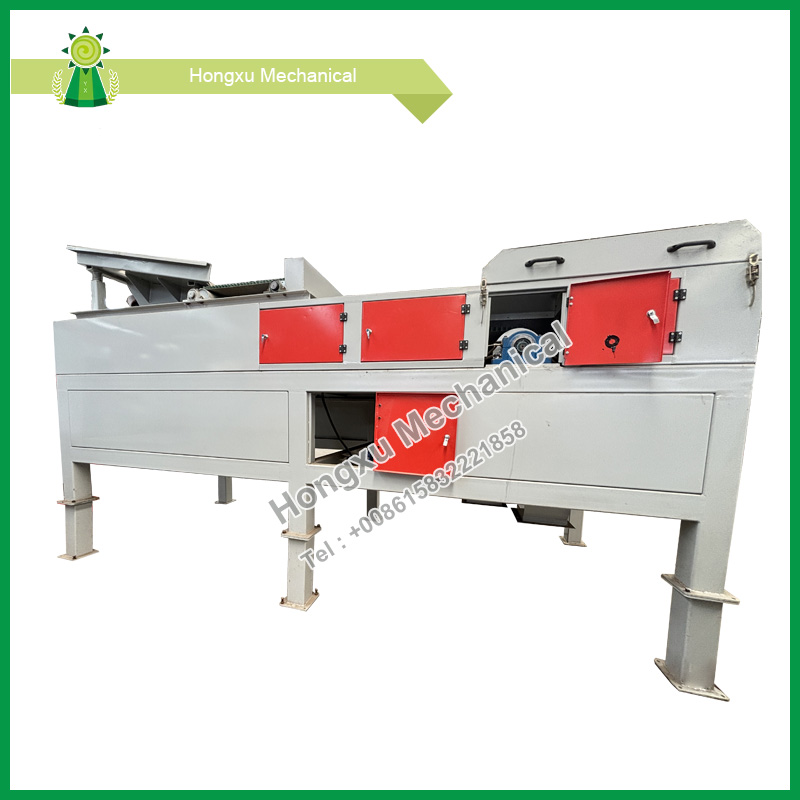
Below is a consolidated specification summary representing a typical high-performance industrial eddy current separator configuration:
| Parameter | Specification |
|---|---|
| Applicable Materials | Aluminum, copper, brass, zinc, UBC cans, non-ferrous fines, shredded electronics, plastic-metal mixtures, MSW residue |
| Material Size Range | 5–150 mm (configurable by rotor design) |
| Rotor Type | High-speed eccentric or concentric magnetic rotor |
| Rotor Speed | 2,000–4,500 RPM (depending on model and material profile) |
| Magnetic Pole Configuration | 12–40 poles, rare-earth NdFeB magnet system |
| Belt Width Options | 600 / 800 / 1000 / 1200 / 1500 mm |
| Belt Material | High-elastic wear-resistant polyurethane conveyor belt |
| Frame Material | Carbon-steel or stainless-steel structural frame |
| Drive System | Variable-frequency drive (VFD) motor control |
| Throughput Capacity | 1–25 tons per hour depending on feed density and particle size |
| Separation Efficiency | Up to 98% for standard aluminum fractions under optimized conditions |
| Power Requirement | 3–15 kW (dependent on model size) |
| Installation Configuration | Stand-alone unit or integrated in MRF/MPS waste sorting systems |
How Does an Eddy Current Separator Improve Non-Ferrous Recycling Processes?
An eddy current separator enhances recycling efficiency by introducing a high-intensity alternating magnetic field that interacts exclusively with conductive non-ferrous materials. When these materials enter the magnetic field, electrical eddy currents are induced, creating opposing magnetic forces that expel the particles forward or sideways from the waste stream. By contrast, non-conductive materials—plastic, wood, paper, glass, and most ferrous residues—follow the belt’s natural trajectory and fall normally.
In industrial recycling operations, the technology is deployed in scenarios where fine-to-mid-size metal fractions require clean separation for resale value, downstream purity, and compliance with industry specifications. Applications include:
-
Municipal solid waste processing
-
Construction and demolition recycling
-
Automotive shredder residue (ASR) handling
-
Electronics dismantling and WEEE recycling
-
UBC (Used Beverage Can) recovery
-
Plastic flake purification
The equipment integrates with vibrating feeders, magnetic drum separators, optical sorters, and density separators to form a multi-stage recovery line. The primary operational goal is to maximize non-ferrous yield while minimizing product contamination and maintaining stable throughput.
A deeper technical evaluation revolves around several high-impact process questions:
How does rotor speed influence the separation trajectory and overall recovery rate?
Rotor speed determines the magnetic field frequency and intensity applied to metal particles. Higher rotor speeds generate stronger repulsive forces, enabling lighter particles—such as aluminum flakes and foil—to be ejected more effectively. However, excessive speed may cause instability, dust generation, or mis-throws. The optimal setting depends on particle size distribution and material density.
How does feed uniformity affect performance and downstream purity?
Uniform feed thickness ensures consistent exposure to the magnetic field. Overloaded or unevenly distributed feed reduces separation accuracy, requiring adjustments to vibratory feeders, belt speeds, or chute configurations.
How Do Different Eddy Current Rotor Designs Affect Sorting Accuracy?
Rotor design is one of the most influential variables governing separation efficiency. Two configurations dominate industrial applications: concentric rotors and eccentric rotors.
Concentric Rotor
In this design, the magnetic rotor is aligned centrally within the shell. The magnetic field is uniform across the width of the belt, making it effective for general non-ferrous applications and bulk sorting. Concentric designs are typically more durable and stable at high throughput.
Eccentric Rotor
The magnetic rotor is offset relative to the housing, creating a more concentrated magnetic field on one side of the machine. This configuration provides enhanced separation for small or lightweight metal fragments because it minimizes ferrous interference and reduces wear on the belt. It also features easier maintenance due to reduced ferrous dust accumulation.
Pole Count and Magnet Strength
High pole counts produce rapid magnetic polarity changes, which improve separation of small particles but reduce maximum throw distance. Conversely, low pole counts generate deeper magnetic fields suitable for larger or denser materials.
Belt Speed and Trajectory
Belt speed and rotor speed must be harmonized to achieve clear throw separation. If belt speed is too low, particles may fall prematurely; if too high, repulsive forces may not fully act on small fractions.
Operational Question for Deeper Analysis
How should operators adjust pole configuration and rotor speed for materials with high density variance?
High-density metals (like copper or brass) require stronger, deeper-penetrating magnetic fields and moderate belt speeds. Low-density metals (like aluminum) respond best to high-frequency alternating fields and faster rotor speeds.
How Can Separation Efficiency Be Optimized in Real-World Plant Environments?
Achieving consistent high-grade metal purity requires attention to plant-level variables that influence feed behavior, equipment durability, and system integration. In practical recycling-line environments, the following factors drive long-term performance.
Upstream Material Conditioning
Pre-screening and size-classification ensure that only appropriately sized particles reach the eddy current separator. This reduces turbulence, improves throw separation, and minimizes mixed trajectories.
Dust Control
Excessive dust shields particles from magnetic exposure and generates maintenance issues. Installing dust collectors or isolation covers helps maintain stable performance.
Ferrous Removal
Any ferrous metal remaining in the feed can adhere to rotor components, disrupting magnetic field behavior and causing wear. Upstream magnetic drums or overband magnets must completely remove ferrous contaminants.
Rotor Maintenance
Regular cleaning prevents fine ferrous particles from accumulating on housing surfaces. This ensures consistent magnetic field intensity.
Environmental Conditions
Humidity, temperature, and feed moisture can impact friction, belt wear, and particle flight paths. Protective enclosures and environmental controls improve consistency.
Data-Driven Optimization
Throughput and purity can be monitored by real-time sensors or optical inspection systems. Recorded metrics support ongoing calibration of belt speed, rotor RPM, and feed distribution.
Advanced Operational Question
How do environmental factors—such as humidity or feed moisture—alter chute trajectory calculations and influence metal-recovery outcomes?
Moisture increases cohesion among particles, reducing flight stability after repulsion. This causes short or inconsistent trajectories, requiring adjustments to belt speed or chute angles.
How Will Eddy Current Separator Technology Evolve to Align With Future Recycling Demands?
As global recycling systems accelerate toward automation, data intelligence, and higher purity standards, eddy current separators are evolving to meet more complex material-recovery challenges. Several development directions are shaping future equipment generations.
Integration With AI-Assisted Sorting Lines
Although the separator itself relies on electromagnetic physics, upstream and downstream systems are increasingly adopting real-time imaging and analytics to refine feed density, particle orientation, and system balancing. This enhances performance stability and reduces operational uncertainty.
More Powerful Magnetic Alloys
Future NdFeB alloys will enable stronger, faster-cycling magnetic fields within compact rotor assemblies. These improvements will increase recovery of ultra-light materials, including thin aluminum laminates, micron-scale particles, and shredded composite metals.
Energy-Optimized Drives
Next-generation VFD systems will dynamically adjust rotor speed based on feed characteristics, reducing energy consumption while maintaining consistent output quality.
Enhanced Rotor Protection and Wear Control
Improved belt materials, abrasion-resistant coatings, and sealed rotor housings will extend equipment lifespan under high-dust, high-abrasion recycling conditions.
Modular Separation Platforms
Plants will increasingly adopt modular lines that allow eddy current separators to integrate with optical sorters, ballistic separators, and density tables, supporting closed-loop recycling operations and higher purity thresholds.
Frequently Asked Questions
What materials cannot be separated by an eddy current separator?
Non-conductive materials such as plastic, glass, wood, rubber, and most ferrous metals cannot be separated by this technology. Ferrous metals must be removed upstream because they can create mechanical wear and interference with the magnetic rotor. Materials with extremely low conductivity or magnetically shielded surfaces may also show reduced separation response.
How is the separation efficiency of an eddy current separator measured in industrial settings?
Efficiency is typically measured through sample analysis of the discharge streams—non-ferrous fraction purity, residue contamination percentage, and mass recovery rate. Controlled test runs compare input mass versus recovered metal mass, providing a quantitative measure of performance. Plants often evaluate purity at multiple particle sizes to ensure consistent results across the entire material profile.
Eddy current separators play a central role in modern non-ferrous recycling operations, enabling high-purity recovery of valuable metals across municipal waste, industrial residues, and complex mixed-material streams. Their efficiency depends on rotor design, magnetic frequency, feed conditioning, environmental stability, and system integration. As recycling standards rise and global circular-economy initiatives expand, the importance of reliable and high-precision metal-separation equipment continues to grow. Hongxu® provides industrial-grade eddy current separator solutions engineered for durability, efficiency, and long-term operational stability.
For additional specifications, custom configurations, or technical consultation, contact us to discuss equipment selection and system integration requirements.